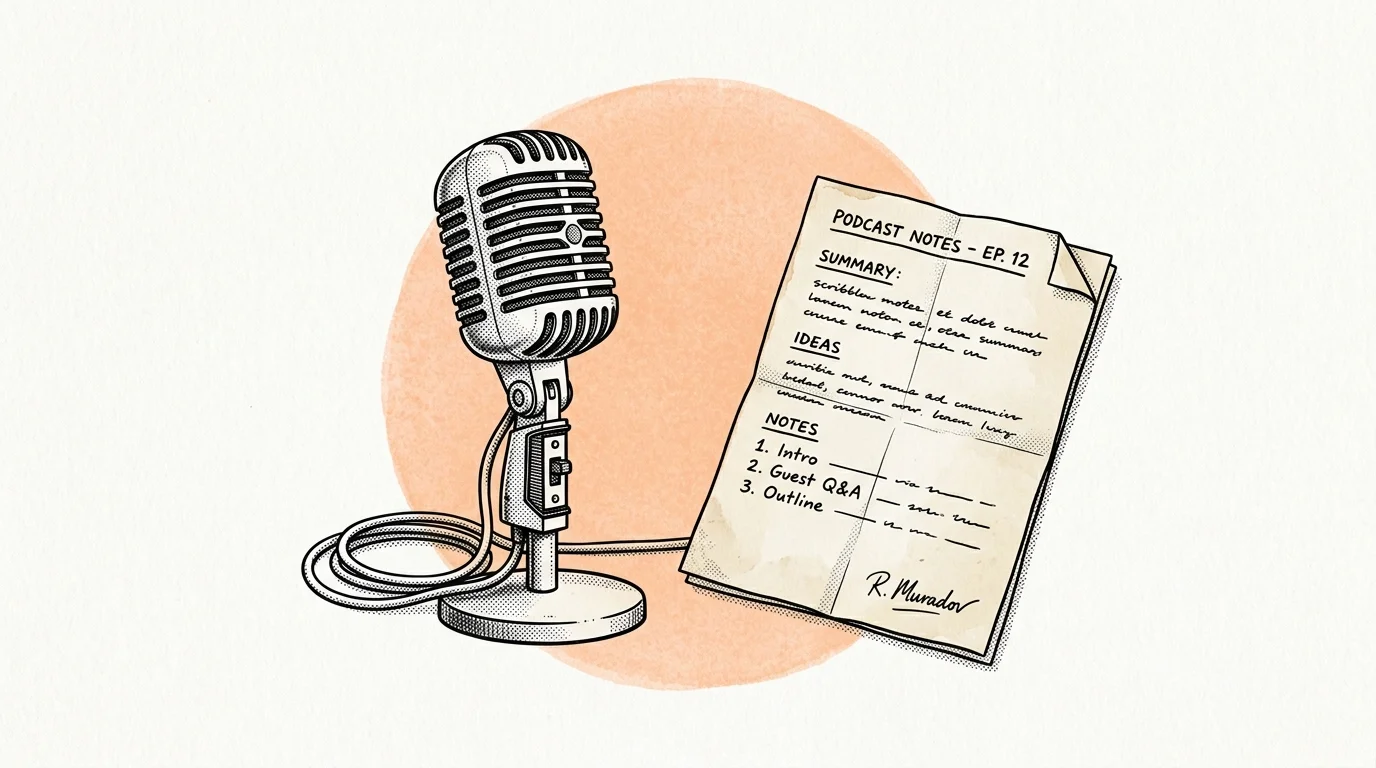
Video interviews are among the richest sources of qualitative data, industry insights, and primary research available on YouTube. Deep-dive discussions, podcasts, and executive fireside chats often span one to three hours, containing detailed anecdotes and expert opinions. However, finding the specific insight you need inside a 2-hour conversational file is like looking for a needle in a haystack. Manually parsing these transcripts or sitting through hours of audio is a massive drag on productivity.
Using a modern YouTube video summarizer tool can automate this entire process. With advanced artificial intelligence, you can transcribe long interviews, clean the raw dialogue, separate speakers, and generate concise outlines in seconds. In this tutorial, we will show you how to leverage AI to summarize long video interviews without losing critical nuance or crashing language models.
💡 Tip: Skip manual transcript cleaning. You can summarize video interviews of any length (up to 4 hours) directly inside YouTube with the AI Summary Chrome Extension.
The Dialogue Challenge: Why Conversational Transcripts Fail Standard AI
Conversational video transcripts are fundamentally different from structured educational lectures. In lectures, a single speaker delivers a cohesive narrative. In interviews, two or more speakers converse dynamically, leading to specific transcription challenges:
- Overlapping Speech and Interjections: Back-and-forth chatter (e.g. \"right\", \"exactly\", \"yeah\") clutters raw transcript files.
- Sentence Fragments: Speakers frequently change direction mid-thought, creating fragmented, run-on sentences.
- Speaker Attribution: Without separating who said what, a raw text block is extremely difficult to read or summarize accurately.
To overcome these challenges, your summarization workflow must use tools designed to parse dialogue structures and recognize shifts in conversational topics.
How to Segment and Summarize Long Interviews Step-by-Step
1. Extract the Raw Video Transcript
First, you need to extract the video transcript from YouTube. While YouTube provides a native transcript panel in the video description, copying and pasting it manually is tedious and strips out formatting. Using a dedicated scraper extension or a web utility allows you to download the transcript in one click with timecodes intact. This serves as the foundation for the AI model's analysis.
2. Apply Conversational Chunking
If the interview runs longer than 90 minutes, passing the entire transcript into standard LLMs in a single prompt can cause context decay or result in a truncated output. To maintain full detail, segment the transcript into conversational chapters (e.g., 30-minute intervals). Instruct the model to summarize each section separately before merging them into a unified document. This ensures that valuable anecdotes from the middle of the discussion are not forgotten.
3. Format the Interview Summary
A high-quality interview summary should not be a single wall of text. It should follow a structured, scannable layout:
- Key Takeaways Panel: A 3-sentence summary of the main thesis or most important lesson from the interview.
- Speaker Profiles: A brief description of each participant and their main perspective.
- Chronological Chapter Outlines: Timecoded headings linking to specific discussion topics (e.g.
[12:45] Starting the company) followed by key bullet points. - Direct Quotes: Verbatim text blocks of highly impactful quotes, preserved for reference.
Maximizing Your Research Efficiency
Once you have generated your structured summary, the real learning begins. Export the markdown notes to your Notion database or Google Docs folder. You can then use these summaries to build a searchable knowledge base, allowing you to query across multiple interviews. Instead of rewatching hours of video, you can search for a keyword and immediately locate the exact quote and timestamp across your entire collection.
Conclusion
Summarizing long video interviews with AI is a game-changer for content creators, researchers, and students. By automating transcription and outline generation, you turn linear video content into interactive, searchable data. For researchers conducting frequent competitor analysis or students studying guest lectures, adopting an AI-assisted summarization workflow is the most effective way to scale information intake without getting overwhelmed by screen time.
Previously: Best YouTube Summarizer Options for Long Tutorials ← · Next read: Top AI YouTube Tools to Save Hours of Watching →
Related: Best YouTube Summarizer Options for Long Tutorials · YouTube Transcript Guide: How to Extract Video Scripts